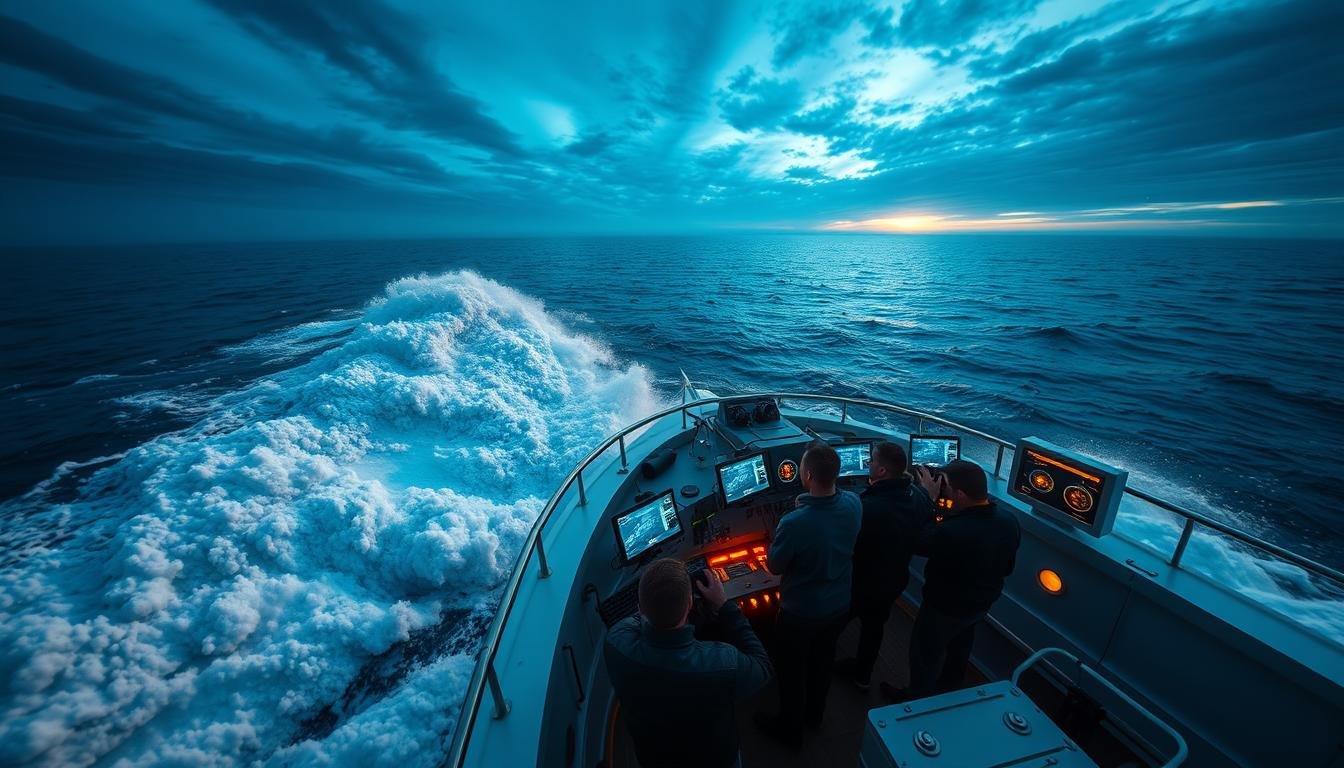
The world’s oceans cover over 70% of the planet. Yet, they are still one of the most under-explored places on Earth. The depths of our oceans are full of mysteries.
Ocean exploration is key to understanding the ocean’s ecosystems. It also helps us see how human activities affect marine life. New technology has let scientists dive deep into the deep-sea like never before. This has led to many exciting deep-sea discoveries.
We need to keep exploring our oceans. By doing so, we can manage marine resources better. We can also fight climate change and make new scientific discoveries.
Key Takeaways
- The world’s oceans are vastly under-explored.
- Ocean exploration is crucial for understanding marine ecosystems.
- Recent technological advancements have enabled detailed deep-sea exploration.
- Continued ocean exploration is necessary for managing marine resources and mitigating climate change.
- New discoveries in the ocean can lead to significant scientific breakthroughs.
The Vast Blue Wilderness
The oceans cover over 70% of our planet, making up a vast blue wilderness. This huge area is not just a fact; it shows how important oceans are to our ecosystem. They also hold many mysteries waiting to be uncovered.
Ocean Coverage and Depth Statistics
The world’s oceans are not just vast; they are also incredibly deep. The average depth of the ocean is about 3,700 meters. The deepest point, in the Mariana Trench, reaches an amazing 11,000 meters.
The Five Oceans and Their Dimensions
| Ocean Name | Area (km²) | Average Depth (m) |
|---|---|---|
| Pacific Ocean | 155.6 million | 3,970 |
| Atlantic Ocean | 85.1 million | 3,332 |
| Indian Ocean | 73.5 million | 3,741 |
| Southern Ocean | 20.3 million | 4,000 – 5,000 |
| Arctic Ocean | 14.0 million | 1,038 |
Why Oceans Remain Largely Unexplored
Despite their importance, oceans are still largely unexplored. The challenges are many, including extreme depths and
and oceanography are working to uncover the deep’s secrets. But, there is still much to discover.
Oceans: Earth’s Least Explored Frontiers
As we explore space, it’s amazing how much of our oceans are still unknown. Over 70% of our planet is covered by oceans, yet their depths are a big mystery.
The Exploration Gap: Oceans vs. Space
It’s surprising that we know more about some planets than our own ocean floor. The exploration gap between space and the ocean is huge. There’s a big difference in how much we’ve mapped and explored each.
The 80% Mystery: Unmapped Ocean Floor
A huge 80% of the ocean floor is unmapped, says the National Oceanic and Atmospheric Administration (NOAA). This vast area holds secrets of underwater ecosystems and possibly new species.
Notable Unexplored Regions
Some key unexplored regions are the Mariana Trench, the ocean’s deepest point, and the mesopelagic zone, or “twilight zone.” These places are key for ocean exploration.
Historical Journey of Ocean Exploration
Ocean exploration has a long history, from ancient sailors to today’s scientists. This journey has seen many important moments. These moments were driven by our curiosity and new technologies.
Early Maritime Explorers and Their Contributions
Early explorers were key in mapping the oceans. Explorers like Ferdinand Magellan and James Cook bravely explored the unknown. They found new trade paths and started our scientific journey.
“The sea, once it casts its spell, holds one in its net of wonder forever.” – Jacques Cousteau
The Birth of Modern Oceanography
The HMS Challenger Expedition (1872-1876) started modern oceanography. It was a big step in ocean research. The expedition did detailed studies of the ocean’s physical and biological sides.
HMS Challenger Expedition (1872-1876)
The HMS Challenger Expedition was a key voyage. It thoroughly explored the world’s oceans. The findings were amazing, showing us the ocean’s depths, marine life, and underwater geology.
| Expedition | Year | Key Discoveries |
|---|---|---|
| HMS Challenger | 1872-1876 | Comprehensive ocean surveys, marine life discoveries |
| Ferdinand Magellan | 1519-1522 | First circumnavigation of the globe |
20th Century Breakthroughs in Ocean Discovery
The 20th century brought big steps in ocean discovery. New tech like manned submersibles and ROVs let scientists dive deep. They could explore the ocean in ways never seen before.
Modern Technologies Unveiling the Deep
The deep sea is a vast, unexplored frontier. Modern technologies are changing how we see the ocean’s depths. These tools are key to understanding the complex life below the waves.
Manned Submersibles and Their Discoveries
Manned submersibles have been crucial in exploring the deep sea. They let humans see and record the underwater world. Notable examples include the Trieste and Deepsea Challenger, which have reached record depths and made significant discoveries.
From Trieste to Deepsea Challenger
The Trieste was the first to reach the Mariana Trench’s bottom, going 35,787 feet deep. The Deepsea Challenger also reached 35,787 feet in 2012. These dives have given us valuable insights into the ocean’s deepest parts.
Remote Operated Vehicles (ROVs)
ROVs are robotic subs that can be controlled from the surface. They have manipulator arms and high-definition cameras. This lets them collect samples and observe the deep-sea environment in detail.
Sonar, Satellite Mapping, and Autonomous Vehicles
Sonar and satellite mapping have changed how we map the seafloor. They give us detailed maps of the ocean floor. Autonomous underwater vehicles (AUVs) also help, conducting surveys and gathering data in hard-to-reach areas.
Challenges of Deep-Sea Exploration
The ocean’s depths are full of challenges for explorers. Even with new technology, exploring the deep sea is still hard and scary.
Physical Barriers: Pressure, Temperature, and Darkness
The deep sea has extreme conditions. It’s very cold, very dark, and the pressure is incredibly high. These conditions make it hard for humans to explore without special gear.
Pressure gets much higher as you go deeper. In the deepest parts, it’s over 1,000 times the pressure at sea level. This means submersibles need to be very strong.
Technological Limitations and Engineering Challenges
Creating tech that can handle the deep sea’s harsh conditions is a big challenge. Engineers must pick the right materials and designs to make sure it works and lasts.
Economic and Logistical Constraints
Exploring the deep sea is not just a tech challenge but also very expensive. Building and running deep-sea vehicles costs a lot of money.
The High Cost of Deep-Sea Missions
A report says deep-sea missions can cost hundreds of millions of dollars. This high cost limits how often and how much we can explore the deep sea.
“The deep sea is a vast and largely unexplored frontier, but it is also a very difficult and expensive place to explore.”
Remarkable Discoveries from the Abyss
The ocean’s depths are full of surprises. They hold bizarre ecosystems and ancient ruins. Deep-sea exploration has revealed many fascinating phenomena we didn’t know about before.
Unique Ecosystems and Unexpected Biodiversity
The deep sea has unique ecosystems that thrive in extreme conditions. These places are full of unexpected biodiversity. Species have adapted to survive in places with intense pressure, near-freezing temperatures, and total darkness.
Hydrothermal Vents and Extremophile Life Forms
One major discovery is the hydrothermal vents. These underwater springs release superheated water rich in minerals. They support a unique community of extremophile life forms. These life forms can survive in conditions that were thought to be inhospitable to life.
Underwater Archaeological Treasures
The ocean floor is also a treasure trove of underwater archaeological treasures. Explorations have found ancient shipwrecks and lost cities. These discoveries give us insights into human history and cultural heritage.
Shipwrecks and Lost Cities
Notable finds include the shipwrecks of historical vessels and the remnants of lost cities. These discoveries help us understand maritime history and the growth of human civilizations.
The Future of Ocean Exploration
Ocean exploration is on the verge of a big change, thanks to new tech. As we move forward, new tools and ways of exploring will help us learn more about the deep sea.
Emerging Technologies and Methodologies
New tech like advanced sonar, AUVs, and ROVs are changing how we explore the ocean. These tools help us get more accurate data and explore faster.
International Collaboration and Ocean Mapping Initiatives
Working together globally is key for big ocean mapping projects. Efforts like GEBCO bring experts together to map the ocean floor. These projects help us understand ocean currents, life, and how climate change affects them.
Potential Scientific Breakthroughs on the Horizon
The future of ocean exploration is full of scientific possibilities. We might find new species and learn about ocean ecosystems. Advances in marine biology could show us how all ocean life is connected.
Ocean Exploration’s Role in Climate Science
Ocean exploration is crucial for studying climate change. By looking at ocean currents, temperatures, and life, scientists can better understand climate impacts. This knowledge is vital for fighting and adapting to climate change.
Conclusion: Embracing the Blue Unknown
The world’s oceans are still a big mystery, full of secrets waiting to be found. Explorers and new technologies are working together to uncover these secrets. This journey is ongoing, with many important discoveries yet to be made.
The oceans are full of life, from the deep blue to the hot vents on the seafloor. Exploring these areas is crucial. New tools and teamwork will help us learn more about the deep.
Exploring the oceans helps us understand our planet better. It also opens up new chances for science and for us to appreciate the oceans. The future of ocean exploration looks exciting, with many discoveries waiting for us.
FAQ
What percentage of the ocean has been explored?
Only about 5% of the ocean has been explored, says the National Oceanic and Atmospheric Administration (NOAA). This means most of the ocean remains a mystery.
What are some of the challenges faced by deep-sea explorers?
Exploring the deep sea is tough. Explorers face extreme pressure, changing temperatures, and total darkness. There are also tech, money, and planning hurdles.
What is the HMS Challenger Expedition?
The HMS Challenger Expedition was a key voyage from 1872 to 1876. It was the first to explore the oceans methodically. It set the stage for oceanography today.
What are Remote Operated Vehicles (ROVs) used for?
ROVs are unmanned underwater vehicles. They are controlled from the surface. They help explore the seafloor, gather samples, and do research in deep waters.
What is the significance of hydrothermal vents?
Hydrothermal vents are underwater springs that release hot water and minerals. They support unique life forms that thrive in harsh conditions. They are key to scientific discoveries and new species.
How do manned submersibles contribute to ocean exploration?
Manned submersibles take people to deep depths. They allow for direct observation and sampling of the seafloor. They’ve been vital in many historic dives and are still used today.
What is the role of ocean exploration in climate science?
Ocean exploration is vital for climate science. The oceans help regulate the climate. By exploring them, scientists can understand these processes better and predict climate changes.
What are some emerging technologies in ocean exploration?
New tech in ocean exploration includes advanced sonar and satellite mapping. There are also autonomous underwater vehicles (AUVs) and next-generation ROVs. These tools help us map and explore the oceans better.