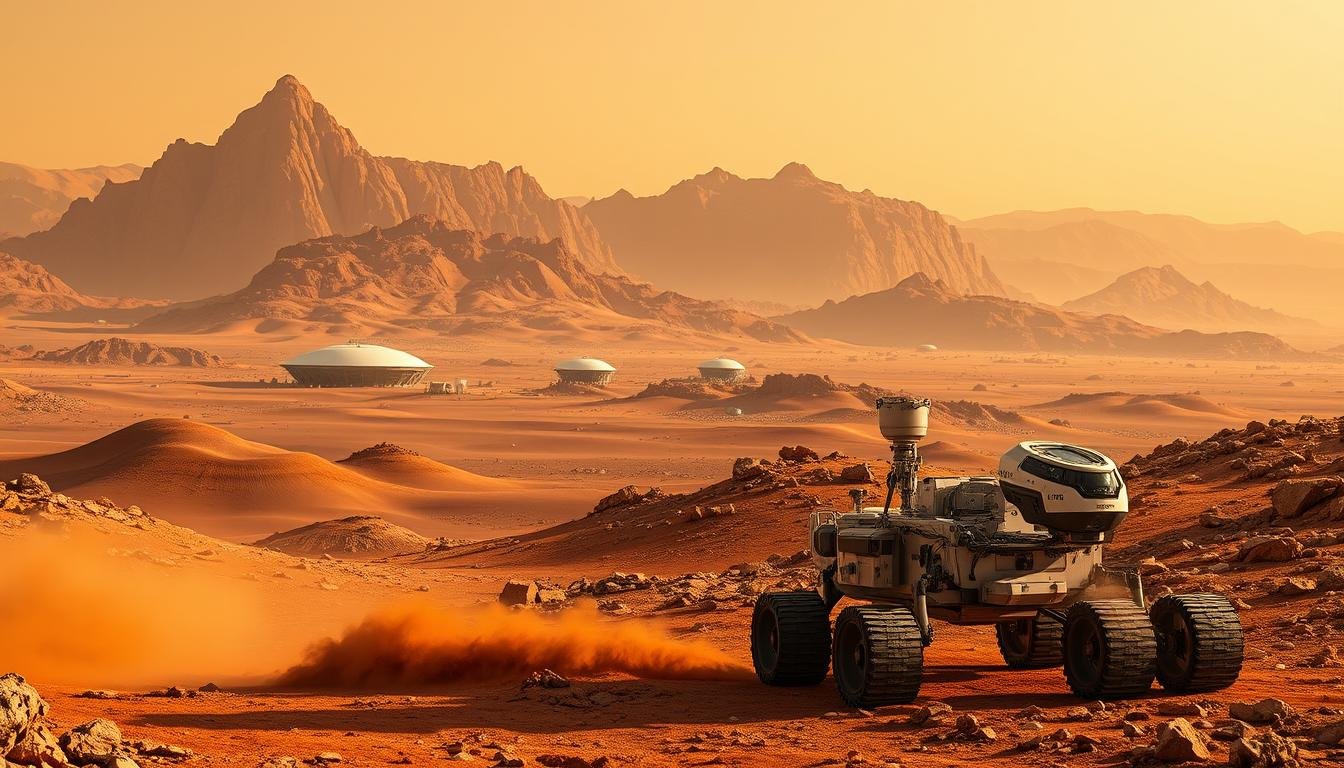
NASA’s ongoing Mars exploration efforts have captured the world’s attention. They are pushing the limits of what we know about the Red Planet. New advancements in space technology have made these missions more advanced, helping us understand Mars’ life-supporting potential.
These Mars missions are more than just exploration. They help us learn more about the universe and our place in it. By studying Mars, scientists can uncover details about the planet’s formation, climate, and life possibilities.
Key Takeaways
- NASA continues to lead the way in Mars exploration with cutting-edge technology.
- Mars missions aim to uncover the secrets of the Red Planet’s past and present.
- Space exploration, including Mars missions, contributes significantly to our understanding of the universe.
- The data collected from Mars exploration missions will be crucial for future human missions.
- International cooperation is playing a key role in advancing Mars exploration.
Current Active Missions on the Red Planet
The Red Planet is currently home to several active missions. These missions are expanding our understanding of Mars. They explore the Martian surface and provide insights into the planet’s geology, climate, and potential habitability.
Perseverance Rover and Ingenuity Helicopter Operations
The Perseverance Rover, launched by NASA, has been exploring Mars since February 2021. The Ingenuity Helicopter has been conducting flight tests. This marks a significant technological milestone in Mars exploration.
Recent Activities and Discoveries
The Perseverance Rover has been exploring the Jezero crater. It has discovered evidence of ancient lakebeds and river systems. These findings are important for understanding Mars’ past habitability.
Technological Milestones Achieved
The Ingenuity Helicopter has successfully demonstrated rotorcraft flight on Mars. It has achieved multiple flight milestones. This technology is crucial for future Mars missions.
Curiosity Rover’s Ongoing Scientific Journey
The Curiosity Rover landed on Mars in 2012. It continues to explore the Martian surface. It has discovered evidence of ancient lakes and methane in the Martian atmosphere.
International Orbiters Providing Mars Surveillance
Several international orbiters, like NASA’s Mars Reconnaissance Orbiter and the European Space Agency’s Mars Express, are surveilling Mars. They help scientists understand the Martian climate, geology, and potential biosignatures.
| Mission Name | Primary Objective | Status |
|---|---|---|
| Perseverance Rover | Explore Jezero crater and search for signs of past life | Active |
| Ingenuity Helicopter | Demonstrate rotorcraft flight on Mars | Active |
| Curiosity Rover | Explore Gale crater and study Martian geology | Active |
Groundbreaking Discoveries from Recent Mars Missions
Recent Mars missions have made many exciting discoveries. These findings are changing how we see the Red Planet. They tell us about Mars’ past, if it could have life, and what future missions will face.
Evidence of Ancient Water Systems and Potential Habitability
NASA’s Perseverance Rover has found signs of old water on Mars. It found sedimentary rocks that show ancient lakes and rivers. This discovery is important for understanding Mars’ past and if it could have life.
Water is key for life. Finding water on Mars means the planet might have supported life before. This makes studying Mars very interesting for scientists looking for life beyond Earth.
Atmospheric Composition and Climate Insights
Recent Mars missions have also learned about the planet’s atmosphere and climate. The Curiosity Rover has studied Mars’ atmosphere for years. It has given us data on its composition, pressure, and temperature changes.
This information helps us understand Mars’ climate and if it could support life. For example, finding methane on Mars has made scientists think about the possibility of microbial life.
Geological Formations Revealing Mars’ History
Mars has some of the most interesting geological formations in our solar system. Recent missions have given us a lot of information about these formations. This includes craters, soil, and rock formations.
Crater Analysis and Soil Composition
Studying craters on Mars has given us insights into its geological history. For example, the Jezero Crater is where the Perseverance Rover is exploring. It’s believed to have been an ancient lake. Scientists are studying the crater’s soil and features to understand Mars’ surface.
Rock Formations and Their Earth Equivalents
Rock formations on Mars have similarities to Earth’s. For instance, the Martian mudstones found by the Curiosity Rover are like those in Earth’s lake beds. This comparison helps scientists understand how these rocks were formed on Mars.
| Geological Feature | Mars | Earth Equivalent |
|---|---|---|
| Mudstones | Formed in ancient lakes | Terrestrial lake beds |
| Crater Fill | Sedimentary deposits | Lake sediments on Earth |
| Rock Formations | Basaltic rocks | Volcanic regions on Earth |
Studying Mars’ geological formations is fascinating. It gives us insights into the planet’s history and if it could have life. As we keep exploring Mars, we will likely find more secrets about the Red Planet.
Latest Updates on Mars Exploration Missions
The latest news from Mars missions is exciting. They are uncovering new things about the Red Planet’s geology and if it could have life. Scientists are working hard to understand Mars better with the data they get.
Mission Status Reports and Recent Achievements
The Perseverance Rover is still exploring Jezero crater. It’s finding out that the crater had a lake in the past. This lake might have supported life.
The Curiosity Rover is in Gale crater. It has found a lot about Mars’ climate and geology.
| Rover | Location | Key Discoveries |
|---|---|---|
| Perseverance | Jezero Crater | Evidence of ancient lake, potential biosignatures |
| Curiosity | Gale Crater | Insights into Martian climate, geological history |
Communication Breakthroughs Between Mars and Earth
There’s been a big step forward in talking to Mars from Earth. Advanced relay orbiters are making it easier to send and receive data. This means scientists can get important information from Mars faster.
Unexpected Findings Changing Our Understanding of Mars
Discoveries like seasonal brine flows on Mars are changing how we see the planet. They show Mars is more complex and dynamic than we thought. These findings are making scientists rethink their ideas about Mars.
Technological Advancements Driving Mars Exploration Forward
Mars exploration is making big strides with new technologies. These advancements help us explore the Red Planet better. They also prepare us for future human missions.
Next-Generation Rover Capabilities and Scientific Instruments
The new Mars rovers come with advanced tools. For example, the Perseverance Rover has instruments to study Martian geology and search for life signs.
These rovers can move better, collect more samples, and analyze them more accurately. They can explore more, gather diverse samples, and give us detailed insights into Mars.
Autonomous Navigation and AI Systems in Space
Autonomous navigation is key in Mars exploration. Artificial Intelligence (AI) and machine learning help rovers navigate Mars efficiently. They can avoid obstacles and make decisions on their own.
This is vital because communication with Earth is slow. AI systems can analyze data, make decisions, and adjust the mission as needed. This boosts the success of Mars missions.
Sample Collection, Analysis, and Preservation Technologies
Collecting and analyzing samples is crucial for Mars exploration. It helps us understand Martian geology, search for life signs, and prepare for human missions.
In-Situ Resource Utilization Experiments
In-Situ Resource Utilization (ISRU) uses Martian resources for missions. It extracts water, produces oxygen, and creates fuel. This reduces the need for supplies from Earth.
Long-Term Sample Storage Solutions
Long-term sample storage is vital for Mars exploration. We need solutions to keep samples safe for future missions. These missions will study and analyze the samples.
| Technology | Description | Benefits |
|---|---|---|
| Next-Generation Rovers | Advanced mobility and sampling capabilities | Enhanced exploration and data collection |
| Autonomous Navigation | AI-driven navigation systems | Increased efficiency and reduced communication delays |
| ISRU | Utilization of Martian resources | Reduced reliance on Earth-based supplies |
Challenges and Obstacles Faced in Current Mars Missions
The journey to Mars is filled with obstacles. These include harsh environmental conditions and complex technical issues. Understanding these challenges is key for the success of ongoing and future missions.
Environmental Hazards and Extreme Conditions on Mars
Mars is a hostile place for exploration. Temperatures can drop to -125 degrees Celsius at night and rise to 20 degrees Celsius during the day. The planet’s thin atmosphere offers little protection from radiation and solar winds.
Dust storms can last for days or weeks. They can damage equipment and disrupt communication systems.
The terrain on Mars is also challenging. It includes rocky landscapes, steep cliffs, and vast dunes. Rovers must navigate these conditions using autonomous navigation systems to avoid hazards and reach their destinations.
Technical Difficulties and Innovative Solutions
Technical issues are common in Mars exploration. Communication delays between Mars and Earth can be from 3 to 22 minutes one way. This delay requires autonomous decision-making for Mars rovers to respond to unexpected situations without human help.
New solutions are being developed to tackle these challenges. For example, AI and machine learning are helping rovers analyze data and make decisions more efficiently. Improvements in communication technology are also reducing the impact of distance on signal transmission.
Resource Management Strategies for Extended Missions
As Mars missions last longer, effective resource management becomes crucial. Rovers must optimize their energy use, often using solar panels and batteries. Managing data storage and transmission is also essential, as the data collected can be vast.
Strategies like hibernation modes during low activity or extreme weather help save energy. Mission planners are also working on more efficient data transmission protocols to handle the large amounts of information collected during extended missions.
Future Mars Missions in Development
Mars exploration is about to enter a new phase. Several important missions are coming up. They will help us learn more about Mars and might lead to humans exploring it.
NASA’s Mars Sample Return Mission Timeline
NASA is working on the Mars Sample Return (MSR) mission. It aims to bring back samples from Mars for study. The mission is set to launch in the late 2020s.
A rover will collect samples, and a separate spacecraft will bring them back to Earth. This mission is key to understanding Mars’ geology and if life exists there.
International Collaboration Expanding Mars Exploration
Space agencies worldwide are teaming up to explore Mars. They share resources and knowledge to advance their goals.
European Space Agency’s ExoMars Plans
The European Space Agency (ESA) is creating the ExoMars rover. It will search for life on Mars and collect samples from beneath the surface. The rover is set to launch in the late 2020s.
Chinese and Indian Mars Mission Roadmaps
China and India are also heading to Mars. China has orbited and landed on Mars, while India has orbited it. They plan to send more missions, including sample return missions.
Private Sector’s Growing Role in Mars Exploration
The private sector is playing a bigger part in Mars missions. Companies like SpaceX are leading the way.
SpaceX’s Starship and Mars Colonization Vision
SpaceX is making the Starship, a reusable spacecraft for Mars and the Moon. The goal is to create a permanent human settlement on Mars. Starship will carry both people and supplies.
Other Commercial Ventures and Partnerships
Other companies are also eyeing Mars missions. They’re teaming up with governments and investors. This could bring new ideas and speed up Mars exploration.
Conclusion: The Evolving Landscape of Mars Exploration
The Mars exploration scene is changing fast. Missions like the Perseverance Rover and Curiosity Rover are revealing Mars’ secrets. They help us understand its history and if life could have existed there.
NASA’s Mars Sample Return Mission and global partnerships are key to learning more. The private sector’s role is also growing. This will bring new ideas and speed up our Mars journey.
Technologies like self-driving systems and AI are making Mars exploration more exciting. As we keep exploring, we might find signs of life on Mars. This could tell us if we’re alone in the universe.
FAQ
What are the primary objectives of the current Mars exploration missions?
The main goals of Mars missions, like the Perseverance and Curiosity Rovers, are to explore the Martian surface. They aim to understand the planet’s geology and search for life signs. They also study the Martian climate and atmosphere.
How do Mars rovers communicate with Earth?
Mars rovers talk to Earth through orbiters around Mars and direct communication. Orbiters like NASA’s Mars Reconnaissance Orbiter and ESA’s Mars Express help by relaying data between rovers and Earth.
What technological advancements are being used in Mars exploration?
Mars exploration uses new tech like autonomous navigation and advanced scientific tools. These include spectrometers and cameras. AI also helps rovers and spacecraft work more efficiently and independently.
What are some of the challenges faced by Mars missions?
Mars missions face many challenges. These include dust storms, extreme temperatures, and communication blackouts. They also deal with equipment failures and need to manage resources to last longer.
What is the significance of finding water on Mars?
Finding water on Mars is key because it shows the planet might have been able to support life before. Water is also vital for future human missions, used for life support, propulsion, and more.
How do international collaborations contribute to Mars exploration?
International teams are crucial for Mars exploration. They share resources, expertise, and risk. Agencies like NASA, ESA, CNSA, and ISRO work together. They share data and coordinate to reach their goals.
What are the plans for future Mars missions?
Future missions include NASA’s Mars Sample Return and ESA’s ExoMars rover. China and India also have plans. Private companies like SpaceX aim to send humans to Mars with their Starship program.
How do Mars orbiters contribute to the exploration of Mars?
Mars orbiters are key by watching the Martian surface and relaying communications. They also do research on the atmosphere and geology from orbit.